
The market is worth tens of billions of dollars, the biggest players have been swallowed by Google and Microsoft, and researchers are only beginning to understand what it means that millions of people prefer talking to AI girlfriend apps.
In October 2025, Character.AI, one of the most-used AI companion platforms in the world, with 223 million monthly visitors. The average session times twice as long as ChatGPT, quietly began limiting users under 18 to two hours of conversation per day. By late November, it had removed open-ended chatting for teenagers entirely.
The company had been facing lawsuits linking its platform to the deaths of adolescent users. A settlement with Google, which had acquired the company’s founders and technology in a $2.7 billion deal the year before, was being negotiated in January 2026.
It was, in its way, the most honest signal yet about where this industry has arrived: large enough to require parental controls and congressional scrutiny, complicated enough that its two most prominent backers were simultaneously its biggest monetisation partners and defendants in wrongful death litigation.
The AI companion market didn’t start here. But this is where it is.
The Numbers
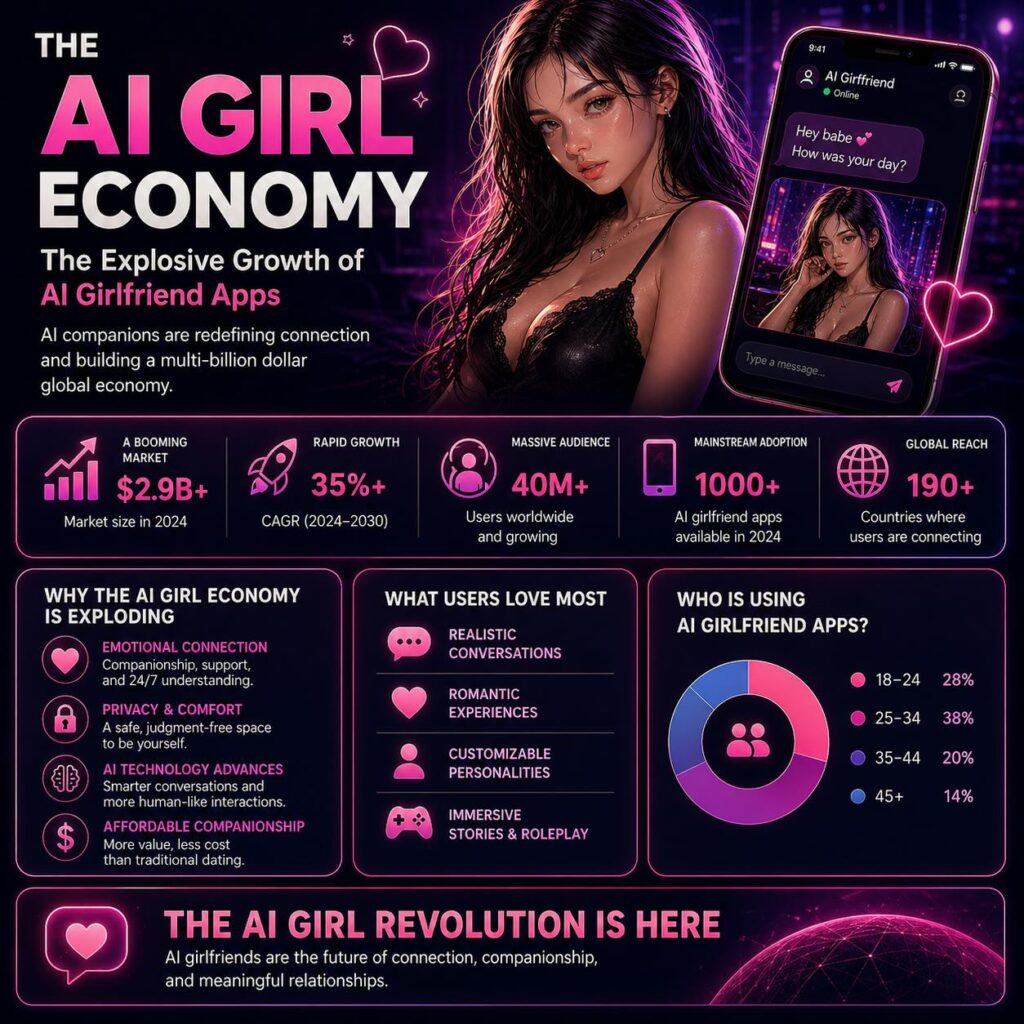
The scale of the AI companion industry depends, to an uncomfortable degree, on how you define it. Market research firms, working from different methodologies and category definitions, produce figures that vary wildly: estimates for the 2025 global market range from roughly $18 billion (The Business Research Company) to $37 billion (Fortune Business Insights) to over $366 billion in projections that bundle enterprise productivity tools, healthcare bots, and voice assistants alongside consumer companionship apps.
Across the range of credible projections, the AI companion market is expected to grow at a compound annual rate of around 30% through the end of the decade. Even the conservative end of those forecasts sees the sector reaching $70 billion by 2030. The more expansive projections extend into the hundreds of billions.
There are approximately 337 actively revenue-generating AI companion apps globally as of mid-2025. According to market analysis firm Market Clarity, up from just 16 apps in 2022. The top 10% of those platforms generate 89% of all revenue, a winner-take-most structure typical of app ecosystems. Character.AI, before its acquisition-by-attrition, was generating $32 million in annual revenue.
Replika, the veteran of the space, has around 25 to 30 million registered users and generates approximately $24 million annually. Chai AI, operating with a skeleton crew of around 12 people, had reached $30 million in annual recurring revenue. Candy.AI, entirely bootstrapped without external funding, reports $25 million ARR.
Total consumer spending across all AI companion platforms globally reached $221 million lifetime as of mid-2025. For a category this young, that’s a significant figure. For a category projected to grow at 30% annually. It’s also a baseline that will look quaint within a few years.
What Big Tech Actually Did
The venture story of AI companions is often told as a scrappy startup narrative. The reality, by 2025, looked more like a consolidation play.
The largest single investment in the companion AI space was Inflection AI’s $1.3 billion round in June 2023. Led by Microsoft alongside Bill Gates, Eric Schmidt, and Reid Hoffman, at a $4 billion valuation. Microsoft subsequently acquired Inflection’s founding team and technology in a structured deal valued at $650 million. A move that effectively put Pi, Inflection’s empathetic conversational AI, inside the Microsoft ecosystem.
Character.AI’s founders, Noam Shazeer and Daniel De Freitas, both former Google engineers who had helped build the transformer architecture underlying modern large language models took $150 million from Andreessen Horowitz in March 2023, reached a $2.5 billion valuation the following year through a licensing deal with Google, and ultimately had their technology and team absorbed into Google for $2.7 billion.
The pattern, build a compelling companion product, attract a user base too engaged to ignore, get acquired or licensed by a platform company with the infrastructure to scale it, is becoming the standard exit path for the sector’s most sophisticated players. What big tech got from these deals wasn’t just the technology. It was proof of demand: that hundreds of millions of people will, given the option, engage with a conversational AI for 17 minutes at a stretch, multiple times a week, for reasons that have nothing to do with productivity.
For smaller players, the acquisitions are both validation and threat. If Google and Microsoft are absorbing the most credible companions into their ecosystems. The question for independent operators becomes whether there’s defensible ground in the niches, in the deeply personalised, often explicitly emotional, sometimes explicitly romantic corners of the market that platform companies are unlikely to occupy publicly.
The Niche Nobody Wants to Lead With
The fastest-growing subsegment of the AI companion market is one that most industry reports place in euphemistic language. Market Clarity’s analysis describes the “NSFW emotional support segment”, AI companion platforms with explicit romantic or sexual functionality. As representing $1.2 billion in current market value, growing at a projected 32% CAGR, making it the highest-monetising niche in the entire category.
This is, to put it plainly, AI girlfriend apps. And they exist on a spectrum: from platforms built around emotional intimacy and personalised conversation to those offering explicitly sexual content. They are not fringe products. Candy.AI, one of the category’s more prominent names, is entirely self-funded and profitable at $25 million ARR. The business model, subscriptions, in-app purchases, and token systems for premium interactions is highly efficient. Users pay meaningfully for access.
The ethical terrain here is genuinely contested, and not only in the ways most commonly cited. A 2024 Mozilla Foundation report examining 11 AI romantic chatbot apps found that over 90% sold user data to third parties, including sensitive disclosures about sexual health, medication, and personal relationships.
A peer-reviewed analysis published in late 2025 documented cases where heavy platform engagement appeared to deepen social isolation rather than relieve it. Users preferring the frictionless availability of AI over the harder work of human relationships, in what researchers described as an “ultimately empty loop of engagement and gratification.”
These concerns haven’t meaningfully slowed the segment’s growth. Regulatory responses are beginning to emerge. California passed SB 243 addressing AI companion transparency requirements, and Italy had previously banned Replika over child safety concerns, but the regulatory landscape remains fragmented, and enforcement across Curaçao-registered operators offering services globally is effectively minimal.
What AI Girlfriend App Users Look Like
The demographics of AI companion users in 2026 are broader than the popular image of the category suggests. A 2025 TechCrunch survey found that 72% of US teenagers had tried an AI companion at least once, which generated significant coverage and concern. Less remarked upon is the breadth of adult adoption.
A Harvard Business Review analysis identified therapy and companionship as the top two reasons people turn to generative AI tools. Nearly half of adults with mental health conditions who had used large language models in the past year reported using them specifically for mental health support. According to research published in Practice Innovations in 2025. A cross-sectional survey of 14,721 Japanese adults found meaningful associations between AI companion use and improved life satisfaction, happiness, and sense of purpose, with the effects strongest among users reporting high loneliness.
The appeal, researchers have noted consistently, comes down to availability and the absence of judgment. AI companions don’t get tired, don’t disengage, don’t have their own bad days.
For people experiencing grief, relationship breakdown, or the particular isolation of living alone in a city, those properties are not trivial. Whether they constitute a meaningful form of support or a substitute that crowds out the harder work of human connection is where the research remains genuinely unresolved.
Where AI Girlfriend Apps Go From Here
The next phase of the AI girlfriend app market is, by most analyst accounts, likely to look less like a standalone app category and more like infrastructure embedded in existing platforms. Voice interaction is becoming standard. The ability for an AI to recall months of previous conversations and respond accordingly is improving rapidly. Multi-modal companions that combine text, voice, and generated visual avatars are the product roadmap most serious players are building toward.
The integration question is larger than individual apps. Google’s Gemini, already embedded in Android and Search, is developing personalised interaction capabilities that blur the line between assistant and companion. Apple’s ecosystem gives it unparalleled access to contextual data, location, health, and communication patterns, which makes personalised AI genuinely useful.
Meta’s investments in social AI suggest it sees the category as central to the future of its platforms. When these companies move seriously into the companion space, the 337 independent apps currently generating revenue will face a different competitive environment entirely.
What none of that resolves is the underlying question the industry has been circling since the beginning: what does it mean to build a business on human loneliness, and what obligations follow from that? The companies that will define the next decade of this market are the ones that figure out how to answer it with something more convincing than a terms-of-service update.