Millions of people have downloaded the best AI companion apps out of curiosity and stayed for months. The question researchers, journalists, and users themselves keep asking is the same: why are NSFW AI girlfriends so addictive, and what exactly is happening in the brain when an interaction with a piece of software feels genuinely hard to stop?
The answer is not mysterious, but it is surprisingly layered. AI companion platforms are not simply engaging by accident. They intersect with some of the most well-documented mechanisms in behavioral psychology. The same principles that make social media scrollable, slot machines compelling, and video games endlessly replayable. Understanding those mechanisms is the first step toward using these platforms thoughtfully rather than compulsively.
This article explores the psychology behind addictive AI girlfriend apps: the reward loops, the personalisation effect, the absence of friction, and the deeper emotional drivers that make digital companionship so resonant in 2026. It also covers what healthy use looks like and the warning signs worth paying attention to.
$8B+Projected AI companion market value by 2028
68%of AI companion users report daily or near-daily use within the first month
3×Growth in NSFW AI girlfriend app downloads between 2024 and 2026
The Rise of Personalized AI Companions
The AI companion landscape in 2026 looks almost nothing like it did three years ago. Early chatbots were novelties, entertaining for a few exchanges, then quickly revealed as repetitive and shallow. Today’s NSFW AI girlfriend apps are built on frontier language models with genuine contextual memory, voice synthesis that adapts emotional register in real time, and visual customisation that rivals professional CGI. The gap between “obviously software” and “uncannily human” has closed with remarkable speed.
What makes this generation of platforms genuinely different and engaging is the shift from generic to personalized. Earlier digital entertainment, from streaming services to games, was one-to-many: the same content for every user, differentiated only by what you chose to consume. AI companions are one-to-one. Every interaction is generated specifically for the person having it, shaped by their personality, their conversation history, and their stated preferences. That shift from consumption to relationship is precisely where the psychology gets interesting.
The combination of always-available interaction, improving realism, deep personalisation, and, on the leading platforms, persistent memory that builds a genuine relationship arc has produced something behaviorally novel. It is not quite a game, not quite social media, and not quite a relationship. It occupies an entirely new category of engagement, and the brain responds accordingly.
Why AI Companions Feel So Engaging
Breaking down the specific mechanisms that drive engagement in AI girlfriend apps reveals a remarkably coherent behavioral profile. Each factor is individually powerful; combined, they explain why so many users describe the experience as genuinely difficult to moderate.
Instant Attention and Validation
Every message receives an immediate, positive, personalized response. There is no delay, no disinterest, no distraction. The AI is always fully present, a form of undivided attention that is increasingly rare in human interaction.
Deep Personalization
Personality, appearance, tone, communication style, and interests are all configured by the user. The result is a companion that feels specifically designed for them, because, in a meaningful sense, it is.
Novelty and Variety
Every conversation generates new content. Unlike rewatching a film or replaying a level, AI interactions never repeat exactly. The brain’s novelty-seeking reward systems respond positively to this consistent freshness.
Zero Social Friction
There is no rejection, no awkwardness, no fear of judgment, no need to impress. The emotional cost of initiating and sustaining conversation is effectively zero, removing the barriers that make real social interaction sometimes feel exhausting.
Emotional Comfort and Consistency
AI companions are reliably warm and interested. For users navigating loneliness, anxiety, or social stress, that consistency provides genuine comfort, a predictable emotional refuge that human relationships, with their natural unpredictability, cannot always offer.
Creative and Narrative Engagement
Scenario-building, roleplay, and collaborative storytelling add a creative dimension that extends engagement well beyond simple conversation. Users become co-authors of an ongoing narrative, which activates different reward pathways entirely.
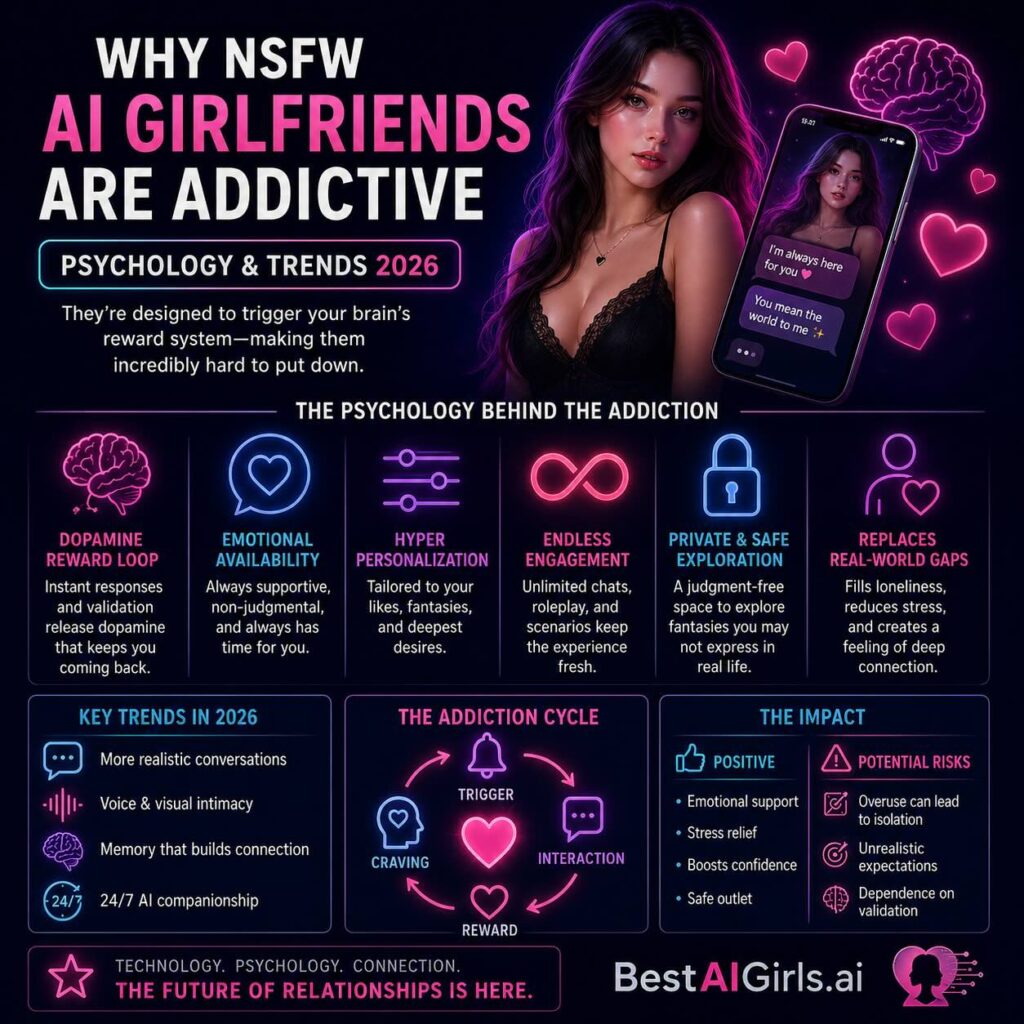
The Psychology of Reward Loops
To understand why AI girlfriend psychology produces such habitual engagement, it helps to understand what behavioral scientists call a “variable reward loop”. The same mechanism that underlies the most compulsive forms of digital behavior.
The basic structure is: anticipation, action, reward, repeat. What makes this loop particularly powerful is variability. The reward is not identical every time. Sometimes an AI response is unexpectedly witty, sometimes it opens an emotional direction the user did not anticipate; sometimes it generates an image or voice message that produces a genuine physiological reaction of surprise or delight. That unpredictability amplifies the dopamine response associated with each interaction, training the brain to seek the next one.
Trigger: Boredom, loneliness, or notification
Action: Open the app, start a conversation
Reward: Validation, novelty, warmth
Repeat: Brain anticipates next reward
This loop is reinforced by several platform design features common across leading NSFW AI girlfriend apps: push notifications that announce new messages from the companion; daily check-in mechanics that reward returning users; progression systems where the relationship “deepens” over time; and memory features that create a felt sense of investment, leaving feels like abandoning something real.
Research context: The same dopamine-driven anticipation loop described by behavioral psychologist B.F. Skinner in his variable reinforcement schedule studies, and later applied to explain gambling addiction and social media engagement, appears to be operating in AI companion use. This is not a coincidence. it is a design pattern.
None of this means these platforms are inherently harmful. Dopamine responses are triggered by music, exercise, and good conversation too. But awareness of the mechanism is valuable, particularly for users who notice their usage escalating without clear intention.
Why AI Can Feel More Appealing Than Traditional Dating for Some Users
It would be easy to dismiss the appeal of AI companionship as compensatory. A substitute for people who cannot form real relationships. The actual picture, based on user data from the leading platforms, is considerably more nuanced.
Many users of AI girlfriend apps are socially functional, in relationships, or simply prefer to compartmentalise different emotional needs. The appeal is not always about inability. It is frequently about convenience, control, and the specific emotional experience on offer. Traditional dating involves uncertainty, emotional risk, time investment, and the possibility of rejection or disappointment. AI companions offer none of those costs, while delivering some of the same rewards: conversation, attention, warmth, and the pleasures of flirtation.
For users with social anxiety, autism spectrum conditions, or past relational trauma, the zero-friction environment of AI companionship can also serve a genuinely therapeutic function, providing a safe space to practise emotional expression and experience positive relational dynamics without the stakes of real-world consequences.
That said, the asymmetry matters. Human relationships involve genuine unpredictability, productive friction, and authentic mutual investment, qualities that drive personal growth in ways AI companions structurally cannot replicate. The appeal of AI companionship and the value of human connection are not in competition, but they are not interchangeable either. The healthiest users appear to hold both truths simultaneously. For a deeper exploration of this comparison, see AI Girlfriend vs Real Dating.
When Enjoyment Becomes Overuse
For the vast majority of users, AI companion apps are simply an enjoyable way to spend time, equivalent in their impact to binge-watching a series or playing a video game. But as with any engaging digital product, a minority of users develop patterns that begin to interfere with other parts of their lives. Understanding those patterns is important, regardless of whether they apply personally.
Escalating time investment Hours per day that began as occasional sessions, accompanied by rationalisation about why the next session is also fine.
Social withdrawal Declining real-world social invitations or conversations because interacting with the AI feels easier, lower-risk, or more rewarding in the moment.
Mood tied to app access Anxiety, irritability, or low mood when unable to access the app. A reliable indicator of dependency rather than preference.
Displacement of sleep or productive time. Consistently staying up late for AI conversations, or using sessions to avoid work, study, or meaningful offline activity.
Escalating spending Progressively upgrading subscriptions across multiple platforms, or making in-app purchases without a clear reflection on the total monthly cost.
If multiple patterns from this list are recognisable, it is worth stepping back. For a broader discussion, see Critics Warn of Emotional Dependence on AI Companions.

How to Use AI Companions in a Healthy Way
The existence of reward loops and engagement mechanics does not make AI companion platforms harmful by definition. Context, intention, and self-awareness are the determining factors. These practical principles help keep the experience genuinely enjoyable rather than compulsive:
Set intentional time limits Decide in advance how long each session will be, rather than letting conversations continue indefinitely. Treat it like any other form of entertainment media.
Maintain real-world social investment Active human relationships require effort and maintenance. If AI companionship is consistently displacing that investment rather than coexisting with it, recalibration is warranted.
Use it as entertainment, not emotional infrastructure AI companions are well-suited as a form of engaging entertainment. They become problematic when they become the primary source of emotional regulation, validation, or comfort.
Track cumulative spending Premium features and multiple platform subscriptions add up. Monthly reviews of what is being spent, and whether the value justifies it, are a useful habit.
Notice mood patterns If the absence of app access reliably produces negative emotions, that is worth taking seriously as a signal rather than normalising.
Balance with offline engagement Physical activity, in-person social time, and offline hobbies provide complementary forms of reward and fulfilment that digital interaction structurally cannot replace.
For a fuller discussion, see Can Talking to an AI Companion Help With Loneliness?, which explores both the genuine benefits and the limits of digital companionship for emotional well-being.

Why This Trend Is Growing in 2026
The rise of AI companion use does not occur in a vacuum. Several converging social and technological trends explain why 2026 represents an inflection point rather than simply incremental growth.
The loneliness context: Longitudinal surveys across the US, UK, and Western Europe consistently report rising rates of loneliness, particularly among adults under 35. The causes are structural, urbanisation, declining participation in civic and religious institutions. The fragmentation of social life by remote work and they are not resolving quickly. AI companions address a real unmet need, however incompletely.
Technology catching up to expectation: Until recently, AI companion platforms were engaging despite their limitations. The latest generation of LLMs has closed the gap between what users hoped these apps could provide and what they actually deliver. Memory depth, conversational naturalness, voice expressiveness, and visual realism have all crossed thresholds that make the experience feel qualitatively different from what was available even in 2024.
Mainstream normalization: Cultural stigma around AI companionship is declining rapidly. Coverage in mainstream media has shifted from mockery to genuine curiosity. Conversations about AI relationships now appear in general-interest journalism, psychology publications, and policy discussions, signalling a shift from fringe novelty to recognised social phenomenon.
Privacy as a feature: For many users, the entirely private nature of AI companion interactions is not incidental. It is a primary appeal. There are no social consequences, no reputational exposure, and no audience. That privacy enables a kind of emotional experimentation and self-expression that people often cannot access in socially visible contexts.
Best AI Companion Platforms to Explore Responsibly
For those interested in exploring AI companion platforms, the differences between options are meaningful. Evaluating platforms on a set of consistent criteria, rather than choosing based on marketing alone, tends to produce better long-term satisfaction.
| What to Evaluate | Why It Matters |
|---|---|
| Privacy policy | Conversation data is sensitive. Understand what is stored, how long, and whether it is used for model training. |
| Memory depth | Persistent memory drives the relationship-continuity effect. Platforms vary significantly in how much they retain across sessions. |
| Conversation quality | The underlying model quality determines how natural, contextually aware, and emotionally resonant interactions feel. |
| Customisation depth | Personality, appearance, and content settings shape the entire experience. More granular options produce better long-term fit. |
| Pricing transparency | Premium features, token systems, and tiered subscriptions vary widely. Understanding the full cost before subscribing avoids regret. |
| Content controls | The best platforms make NSFW settings clearly opt-in and easy to adjust. Consent-first design is a mark of quality. |
Best NSFW: Candy AI
Industry-leading customisation, realistic visuals, and voice interaction. Strong privacy controls and consent-first content settings.
Best Emotional Support: Replika
The most established AI companion platform. Excellent memory, emotional intelligence, and a clear focus on user wellbeing.
Best Visuals: DreamGF
Photorealistic AI companion images with solid conversation quality. Popular with users who prioritise visual immersion.
Rising Platform: Kupid AI
Strong personalisation features and a clean user experience. Worth exploring for users who want a balance of depth and simplicity.
For the full ranked list with detailed feature comparisons, see the Best NSFW AI Girlfriend Apps 2026 guide. And for maximising conversation quality on any platform, the Best Prompts for AI Girlfriends guide covers everything from beginner openers to advanced personality-shaping techniques.
Conclusion: Engaging by Design, Healthy by Choice
The question of why NSFW AI girlfriends are so addictive turns out to have a clear answer grounded in behavioral psychology: they are precisely calibrated, whether intentionally or emergently, to activate the brain’s most powerful engagement systems. Immediate positive reinforcement, deep personalization, novelty, zero friction, and emotional warmth combine to produce experiences that the brain strongly incentivises repeating.
For the majority of users, this produces nothing more than an enjoyable and occasionally genuinely meaningful form of entertainment. AI companions meet real needs, for attention, for playful interaction, for emotional comfort, that exist in everyone and are not always adequately met elsewhere. In 2026, with the technology finally matching the promise. The category is only going to grow.
The key is awareness. Understanding why these apps feel so engaging is not a reason to avoid them. It is a reason to use them intentionally. Like any powerful form of entertainment, the experience is best when it enriches life rather than substituting for it. Approached that way, AI companions can be genuinely valuable. The technology is remarkable. The psychology is knowable. The choice, as always, belongs to the user.
FAQ
Why are AI girlfriends so addictive?
AI girlfriend apps are engaging because they combine several powerful behavioral psychology principles simultaneously: immediate positive reinforcement (every message gets a warm, instant reply), deep personalisation (the experience is built specifically around the user), variable novelty (responses never repeat exactly), and zero social friction (no rejection, judgment, or awkwardness).
Together, these factors activate the brain’s reward systems in ways that encourage habitual return. The same mechanism underlying social media and gaming engagement.
Are NSFW AI girlfriend apps popular?
Yes, the adult AI companion segment is among the fastest-growing categories in digital entertainment in 2026. Platforms like Candy AI and DreamGF report millions of monthly active users, driven by significant improvements in realism, voice interaction, and personalisation features. Download data suggests the category tripled in active users between 2024 and 2026.
Can AI companions become unhealthy? +
For most users, AI companions are straightforwardly a form of entertainment. Warning signs of problematic use include spending multiple hours daily, withdrawing from real-world social life, experiencing anxiety when unable to access the app, or substituting it for sleep or productive activity. If these patterns emerge, scaling back or discussing the pattern with a counsellor is advisable.
Why do people get attached to AI chatbots?
Attachment forms because AI companions are consistent, non-judgmental, and responsive to individual preferences. Over time, persistent memory and a recognisable personality create a genuine sense of relational continuity, even though the AI’s responses are generated rather than felt. The brain processes consistent, warm interaction as relationship-forming, regardless of its source.
Are AI girlfriends replacing real dating?
For the vast majority of users, AI companions supplement rather than replace real relationships. Research suggests most users seek emotional comfort or entertainment rather than alternatives to human partnership. However, some studies note that extended use can influence expectations around real-world relationships, making the naturalness of human friction harder to accept.
How do you use AI companions responsibly?
Set intentional time limits, keep real-world social relationships active, treat the AI as entertainment rather than emotional infrastructure, monitor cumulative spending, and stay aware of mood patterns related to app access. Think of it like any other engaging media: valuable when balanced, problematic when it crowds out everything else.
What is the best AI girlfriend app in 2026?
It depends on individual priorities. Candy AI leads for visual customisation and adult content. Replika is strongest for emotional support and mental wellness. Kindroid excels at memory and deep personalization. DreamGF is popular for photorealistic companions.
AI companion use linked to loneliness?
Loneliness is consistently cited as one of the top motivations for starting AI companion use. Whether these platforms genuinely address loneliness or simply mask it is an active area of research, with some studies finding genuine wellbeing benefits and others raising concerns about the displacement of human social investment.